
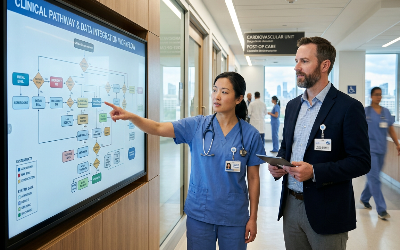
Clinical Informatics Analyst Program
Online
5-7 Courses
Self-Paced
Industry aligned
Clinical Informatics Analyst Program
$75.00
The Clinical Informatics Analyst program is a 5-7 course, online, asynchronous certificate that trains professionals to bridge the gap between healthcare IT and clinical practice. Rooted in the latest competency frameworks from Digital Health Canada and HL7, it provides highly practical skills in system optimization, interoperability, and change management. By focusing on immediate regulatory requirements and future-forward technologies like AI, the program ensures graduates are ready to lead critical digital health transformations.
Description
Join the CIA Program
If your are planning on completing the full program or more than one course, there are some advantages to joining:
Enhanced Experience: Once we know of your interest in the program, we will make it easier for you to track your progress and get updates concerning the program and your next steps.
Save Money: We provide discounts on course tuition to program members. You will save $50 off the cost of each program course. Once you take two courses, you will have covered the program membership cost. Other Information:
It’s Optional: Joining the program is optional. You can still take courses without joining.
Course Sequence: We recommend taking the course of the program in sequence because the content for courses build on what has been already covered.
Only logged in customers who have purchased this product may leave a review.

Related products
Clinical Informatics Analyst Professional Certificate Program
The Clinical Informatics Analyst (CIA) Certificate is a competency-based, 7-course professional program delivered entirely online in an asynchronous format designed for adult learners. Positioned at the critical intersection of technical infrastructure and frontline patient care, this program prepares you to be a “Hybrid Steward” and operational implementer within modern healthcare systems. As the Canadian healthcare sector reaches a digital-first regulatory tipping point in 2026, there is an urgent need for professionals who can safely and efficiently integrate data into clinical workflows. The curriculum is deeply aligned with authoritative frameworks from Digital Health Canada, HL7 Canada, and CIHI, ensuring your skills meet explicit employer demands. Furthermore, the program is future-proofed by integrating emerging trends like generative AI, algorithmic ethics, and sustainable “Green IT,” positioning you for long-term career growth in a rapidly evolving field.
Regulatory Ready by 2027 🛡️
Gain the explicit competencies required to audit compliance with Bill S-5 and validate HL7 FHIR CA-Baseline exchanges. Prepare your organization for mandatory anti-data-blocking regulations.
Implement Human-Centered Redesign ⏱️
Address the clinician burnout crisis by mastering “Time-Back” informatics and lean clinical mapping. Redesign systems to minimize click burden and prevent alert fatigue for frontline staff.
Lead Emerging Tech Stewardship 🤖
Move beyond basic electronic medical records to manage the responsible adoption of Generative AI and Ambient Scribes. Develop the critical skills needed to audit clinical algorithms for bias, safety, and hallucinations.
Grounded in Ethical Governance 🌍
Uniquely operationalize Indigenous Data Sovereignty (OCAP) principles directly into system configurations. Champion sustainable IT solutions by embedding ESG and Green IT practices into healthcare infrastructure.
Carrer Area Analysis
The Clinical Informatics Analyst (CIA) represents a rapidly growing, mission-critical profession at the heart of healthcare’s digital transformation. According to a 2026 outlook from industry leaders and health authorities, the demand for health informatics professionals in Canada is projected to grow by 15% annually through 2030. This surge is largely driven by regulatory mandates like the Connected Care for Canadians Act (Bill S-5), which enforces nationwide interoperability by 2027. Consequently, hospitals and regional health authorities are urgently seeking analysts who can ensure frictionless, compliant data exchange without disrupting patient care.
Beyond immediate compliance, the future of the CIA role is highly secure, strategic, and resilient against economic downturns. Anticipated future developments focus heavily on mitigating the ongoing health human resources (HHR) crisis by automating administrative burdens. CIAs will be at the forefront of implementing ambient AI documentation and Generative AI, returning valuable “time-back” to over-stretched clinicians. Furthermore, as noted in recent global analyses by organizations like McKinsey & Company and the World Health Organization regarding the digital health workforce, the success of massive digital health investments depends entirely on bridging the skills gap. CIAs serve as this critical bridge—operationalizing advanced tech like AI and patient-generated health data (PGHD) while ensuring rigorous algorithmic ethics and Indigenous Data Sovereignty (OCAP). This positions the CIA not just as an IT supporter, but as a crucial leader in building a resilient, sustainable, and equitable healthcare future.
Sources:
McKinsey & Company (2026), “Scaling digital health integration to improve patient care” (https://www.mckinsey.com); World Health Organization (WHO) Digital Health insights; Program Research Report.
Additional Information:
Current market data (May 2026) shows Canadian CIA and Health Informatics Specialist roles commanding competitive salaries generally ranging from $80,000 to over $120,000, depending on regional authority and specialization.
NewPath Admissions
NewPath Learn does not “admit” students in the way that most post-secondary institutions do. We believe that it is our role to communicate to learners what our programs involve and the demands they will place upon learners. Adult learners typically have a wide range of academic credentials, work experience, and other experiences. Given clear information, adult learners are best positioned to make their own decisions about whether they are prepared to begin a program. Our goal is to balance access to our programs with student success. Bottom line: joining one of our programs is up to the learner. We help inform the decision.
Are you Ready?
This program is designed to position professionals at the confluance of strategy and policy, finance, engineering, and community engagement. It recognizes the growing influence of areas like data informed decision making, artificial intelligence, and ESG (Environmental, Social, and Governance) frameworks. As an Asset Manager, you are the connective tissue between these areas as you maximize the value of the assets managed by a governmental or private organization. The program is not intended to prepare you to be, for example, an engineer, financal expert, or data scientist but you must understand the roles of adjacent flields and how to work with them. The design of the program assumes students have a strong set of general foundational skills. Although experience related to Asset Management is helpful, it is not required to begin this program.
To be successful in this program, you must have:
A solid foundation in reading, writing, numeracy, and communication. It is recommended you work at a post-secondary level in these areas.
Expereince and comfort with productivity technology (word processors, spreadsheets, filemanagement, etc.) and information technology (web browsers, email, etc.).
A basic apptitude for financial, communication, and mechanical tasks.
Professional experience related to finance or infrastructure management is an asset.


Reviews
There are no reviews yet.